The Journey of Learning, from Awe to Insight
from Philosophy | 5 minutes read
When you think about it, human creations begin the same way. First there is an idea — a vision of what something could be. Only afterward do we gather the materials and tools needed to bring that idea into reality. Invention, art, engineering, and even businesses often follow this path: imagination first, construction later.
Reverse Path of Education
But when we look at how schools and colleges teach, the process appears almost reversed. Education usually begins with the basics or using raw materials — the fundamentals, the small building blocks, the basic theories — and only after years of learning do students finally reach the ideas or applications, those pieces were meant to create.
This approach certainly has its strengths, but it also creates a problem. When people begin with isolated fundamentals, they often fail to see the magic of the final product. A student learning formulas in physics may not immediately see the wonder of a spacecraft, and someone studying lines of code may not yet grasp the beauty of a working application.
Curiosity, however, tends to awaken in the opposite direction.
When we see something remarkable, something makes us feel in awe, we naturally want to understand it. A person who sees a rocket launch may suddenly want to learn physics. Someone who uses an elegant piece of software may become curious about programming. The learning process begins almost like peeling an onion: you start from the outer layer — the visible creation — and slowly work your way inward toward the core principles that make it possible.
In this sense, creators often see the world from the top down, while academia usually teaches it from the bottom up.
Which approach is actually correct?
The Ladder of Abstraction

The answer may lie in the idea of abstraction. As abstraction is one of the most powerful and also one of the most dangerous concepts in philosophy. As we move deeper into the foundations of things, the level of abstraction increases. The fundamental laws of physics are more abstract than the machines built from them. Mathematical equations are more abstract than the bridges and computers they eventually create.
Different professions operate at different levels of this ladder. A craftsman works closely with physical materials. An engineer works with systems and designs the creation. A scientist often deals with principles and theoretical models that describe reality itself. All of them are part of the same structure, just at different levels of abstraction.
There is also a deeper implication hidden here: the way we name and categorize things does not simply help us describe the world — it actually shapes how we understand the world itself.
Understanding and Naming the World
In the biblical story found in the Book of Genesis, Adam is given the task of naming the animals. At first glance this might seem like a simple act of labeling, but symbolically it represents something more profound. To name something is to recognize its nature, to distinguish it from other things, and to place it within a mental structure of understanding.
Creation, in this sense, already existed both physically and metaphysically. The world was there, but it still needed to be understood, categorized, and made meaningful to the human mind as humans were created in the image of GOD who is the logos* himself.
Human creativity may even reflect something deeper about human nature itself. As Humans are created in the image of God, as described in the Book of Genesis, then creativity could be understood as a reflection of that divine attribute. Just as God creates the world, humans participate in a smaller form of creation by shaping, naming, organizing, and building upon what already exists.
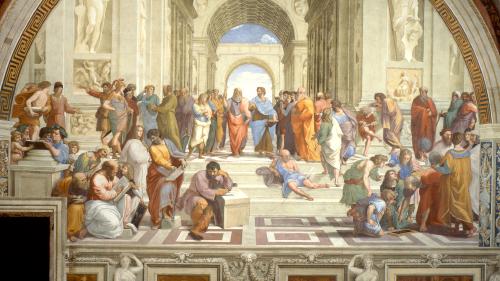
Science follows a similar path. The scientific method begins by observing the world, identifying patterns, naming phenomena, and organizing them into categories. Once these categories exist, we combine them, manipulate them, and build systems out of them.
A chemist identifies elements. An engineer combines materials. A programmer organizes logical structures. In each case, creativity emerges not from nothing, but from learning how different pieces fit together.
Consider a simple example like a smartphone. It is not a complex collection of metalic pieces, circuits, and glass. It is the result of combining multiple layers of knowledge: physics, materials science, electrical engineering, software design, and human psychology. Someone first imagined a device that could connect people, hold information, and fit into a pocket. Only afterward did thousands of smaller discoveries and technologies come together to make that idea real.
In this sense, to be creative is not simply to invent something entirely new. It is to understand the categories of the world well enough that you can reorganize them in unexpected ways.
An interesting dilemma in the modern world.
Our educational systems are extremely good at teaching the pieces — the raw materials, the theories, the categories — yet they often struggle to teach how those pieces come together into meaningful creations. Students may spend years learning fragments of knowledge without ever seeing the larger structure those fragments were meant to build.
Perhaps the most effective way to learn lies somewhere between the two approaches. Wonder should come first, because wonder awakens curiosity. When people see the beauty of a finished creation, they become motivated to explore the deeper layers beneath it. But understanding must eventually follow, because without the fundamentals the wonder cannot be recreated or improved.
Creation therefore moves in both directions at once: from vision to materials, and from materials back to vision.
And perhaps true creativity lies in learning how to travel between those two directions.